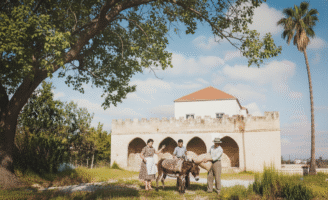
This monograph tracks the history, from biblical times until the 1950s, of Ramat-Yishay. Once a small village nestled in the Jezreel Valley, and today due to its central location, a major hub of commerce. The story of the village reveals a new dimension in the history of Jewish settlement in northern Israel and is accompanied by illustrations, archeological findings, maps, and interviews, uncovering many lost and unknown facts.
The first part of this work studies the history of the village from biblical times until the 19th century and reviews relevant archeological findings and historical sources. It recounts the experiences of travelers who visited the village in the 19th century and present maps from that time.
The second part analyzes the changes the village and its surroundings underwent during the late Ottoman period with special attention to the Ottoman land reform and the ensuing consolidation of large plots of land in the hands of private landholders. Two wealthy Lebanese families, the Sursoks and the Tweines, played a major role in developing the lands after centuries of neglect by the Ottoman Empire. They established residence for tenants who would work the estate's fields, and built a multipurpose estate house, thus contributing to the development of Jeida the precursor of Ramat Yishay.
The third part, beginning at the end of the 19th century reviews the effort of the Zionist movement to purchase Jeida's land and the adjacent area. Lack of finance and the soaring land prices were worsened by the outbreak of World War I, which brought all land transactions to a halt. It was not until 1925 that the lands of Jeida and Tel-Shemmam were purchased, which cleared the way for the foundation of Ramat-Yishay.
The year 1925 marks the beginning of the fourth part which focuses on the attempt of two Jewish associations from Poland to build a private settlement that will combine textile industry and small-scale farming a very different model of settlement than that of other agricultural cooperatives in the area. Their vision turned into reality when they built a textile factory named "Manor" but soon after, the harsh reality struck these inexperienced settlers who faced adversity due to a lack of finance from Zionist institutions. The small settlement struggled for many years to maintain this vision. At last, a glimmer of hope came through the generous contribution of the philanthropist Yishay Adler In the following years, a new wave of immigrants moved in, and the establishment of Ramat-Yishai was finally on its way, although it still took many years for the village to reach its final form.
The recent waves of the commercial development cover much of the tracks of the past, and this project aims to preserve them and adds a novel layer to historical research on Israel.